If you are asking what developer to use, start with the color product—not the volume number. A hair color developer is the oxidizing component paired with color or lightener. Permanent, demi, toner, high-lift, and bleach systems may require different developers even at the same volume.
Identify system, goal, history, and application area; use only developers allowed by product directions.
How to Know What Volume Developer to Use
Use these five questions before opening a developer chart:
| Question | Why it matters |
|---|---|
| What product are you using? | Permanent color, demi, toner, and bleach may use different activators. |
| What is the service goal? | Darkening, gray coverage, tonal correction, and lightening are different jobs. |
| Is the hair virgin or previously colored? | Natural pigment and artificial pigment do not respond in the same way. |
| Where will you apply it? | Roots, lengths, scalp, and off-scalp applications have different conditions. |
| What does the technical guide permit? | Developer, ratio, processing, and application limits belong to the product system. |
In practice, how to choose developer volume depends on the formula and the service being performed.
Hair Developer Volume Chart: Common Roles, Not Universal Rules
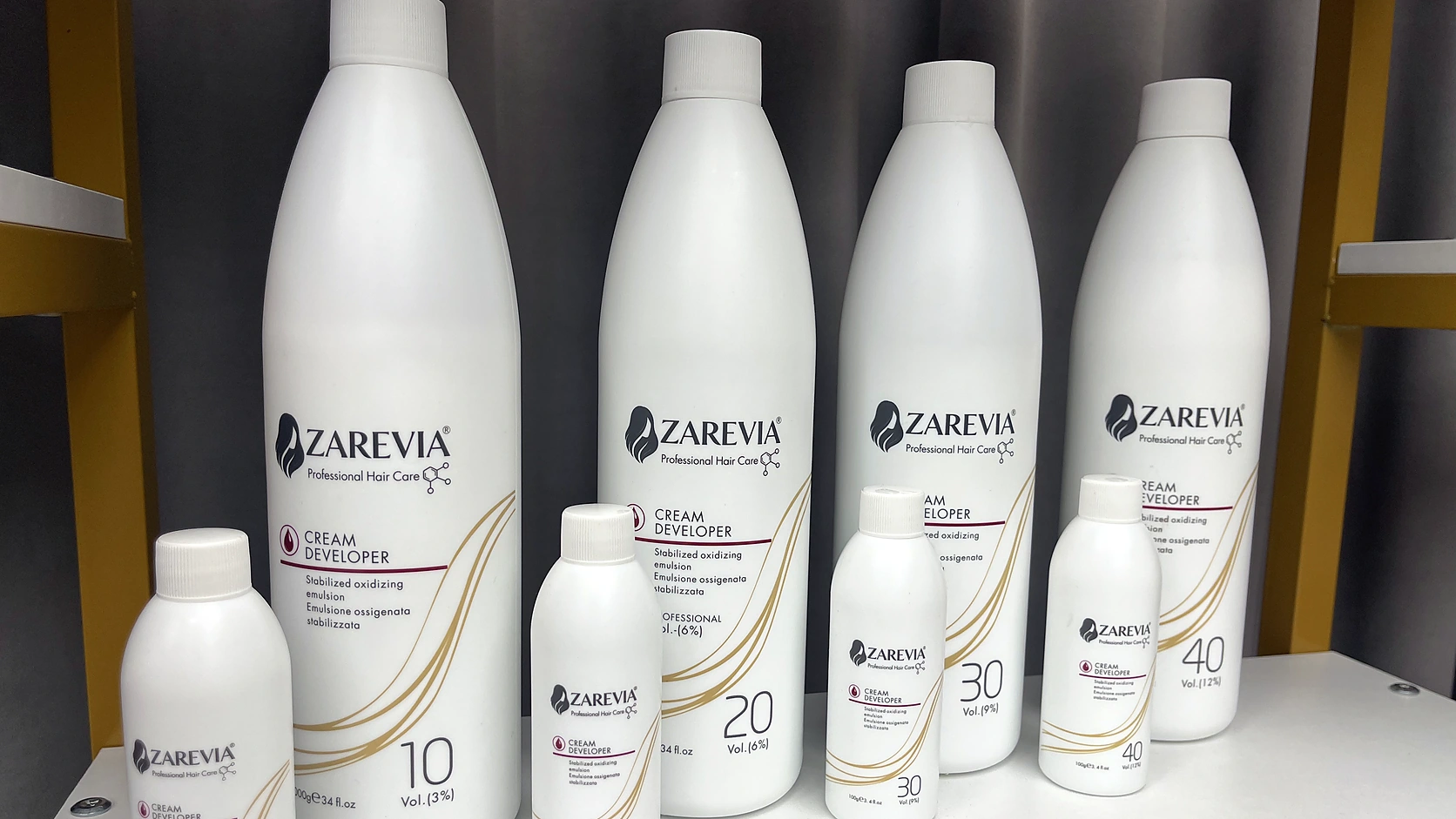
This chart describes common professional roles. The percentage equivalents are common labels, but neither they nor the volume numbers replace manufacturer instructions.
| Developer | Common role | Check first |
|---|---|---|
| Dedicated low-volume activator | Demi color, gloss, or certain toners | Whether the line requires its own activator |
| 10 volume (about 3%) | Deposit, darkening, or limited lift in approved systems | Whether the selected color or toner permits it |
| 20 volume (about 6%) | Some permanent color, gray coverage, and controlled lift services | Goal, starting level, gray system, and product directions |
| 30 volume (about 9%) | Certain permanent, high-lift, or lightener services | Hair condition and scalp/off-scalp restrictions |
| 40 volume (about 12%) | Specific high-lift or professional lightening systems | Explicit manufacturer approval and application limits |
Some systems also use other strengths. A higher volume does not automatically provide better coverage, longer-lasting color, or a better result on dark hair.
Choose the Developer by Product System
Permanent hair color
When deciding what developer to use with permanent hair color, first identify whether the service calls for deposit, darkening, gray coverage, or lift. Then check the approved developer range and shade directions. L’Oréal Professionnel, for example, specifies Majicrème developers for Majirel; those instructions apply to that product system. (L’Oréal Professionnel Majirel)
Demi-permanent color and toner
Many demi colors and glosses use a dedicated low-volume activator. Because “toner” covers several formula types, there is no universal answer to what developer to use with toner.
Redken states that Shades EQ Gloss must be used with Shades EQ Processing Solution rather than another developer. This is a product-specific compatibility rule, not a recommendation for unrelated toners. (Redken Shades EQ Processing Solution)
Semi-permanent direct dyes may use no developer; semi and demi are not interchangeable categories.
Bleach, lightener, and high-lift color
When deciding what developer to use with bleach, consider the lightener, starting hair color level, target, hair condition, and application method. There is no universal winner between 20, 30, or 40 volume. The lightener's directions must permit both the strength and its use on or off the scalp. High-lift color and bleach are different systems, and dark hair does not automatically require the highest volume.
Schwarzkopf Professional presents BLONDME lighteners, toners, and Premium Developers as one coordinated system. Follow the selected lightener’s directions instead of transferring a formula from another brand. (Schwarzkopf Professional BLONDME Service Manual)
Use a product-directed hair color strand test when the formula changes, history is uncertain, or zones may react differently.
Hair History Changes the Decision
Virgin regrowth and previously colored lengths do not provide the same canvas. Permanent color may lift natural pigment within the limits of its system, but increasing the developer is not a reliable way to lift old artificial color.
Assess roots, mid-lengths, and ends separately. Scalp heat, virgin regrowth, porous ends, old highlights, and repeated color can produce hot roots, banding, excessive deposit, or uneven lift. A single whole-head formula may not suit every zone.
Hair condition also matters. Consider porosity, elasticity, previous services, overlap, and the product’s allowed range together. Lower volume does not automatically make an unsuitable goal or compromised-hair service safe.
Dark Hair, Darkening, and Gray Coverage
What developer should you use for dark hair?
Dark hair describes the starting level, not the service. Depositing a brunette shade, covering gray, lifting virgin hair with permanent color, and bleaching dark hair are different jobs. If the hair has already been colored, a stronger developer will not simply remove the existing pigment.
Should you use 10 or 20 developer to darken hair?
Darkening is usually deposit-focused, but the correct activator still depends on whether the selected system is permanent, demi-permanent, or designed for gray coverage. Natural roots and colored lengths may also need different treatment.
Does gray coverage always require 20 volume?
There is no universal rule. Some permanent color systems specify 20 volume for gray coverage, while other coverage or blending systems use a different activator. Check the gray percentage, coverage goal, shade strategy, and directions for the chosen line. For a full diagnostic workflow, see how to cover resistant gray hair.
What Happens If You Use the Wrong Developer?
| Situation or result | Check first | Better action |
|---|---|---|
| Insufficient lift or excess warmth | Starting level, artificial color, product capability, tone, ratio, and application | Do not assume the next step is a higher volume |
| Hot roots, banding, or uneven color | Root heat, porosity, overlap, sectioning, saturation, and zone history | Reassess roots, lengths, and ends separately |
| Declining condition | Starting condition, service intensity, overlap, and repeated processing | Reconsider the target or stop; a lower volume is not an automatic fix |
| 30 instead of 20, or 20 instead of 10 | Lift/deposit balance, tone, coverage, processing behavior, and condition | Use the strength approved for the exact formula |
| Generic, different-brand, or leftover kit developer | Consistency, ratio, stability, tone, and predictability | Substitute only with manufacturer confirmation |
| Mixed, diluted, or developer-only use | Concentration alone does not verify complete formula performance | Obtain the specified system or technical guidance |
If the developer on hand is not approved for the product, do not compensate with extra heat, extra time, or repeated sessions. Wait until you have a compatible product or reliable technical confirmation.
What Professional Buyers Should Check
A professional system should document its shade range, compatible developers, mixing ratios, gray-coverage and lightening scope, application limits, technical guide or SDS, test samples, education, and market-specific supply information.
Professionals evaluating a complete system can review BODA’s Hair Color Products and request the relevant shade chart and technical directions before testing.
Frequently Asked Questions
What is 20 volume developer used for?
Common uses include certain permanent color, gray coverage, and controlled-lift services. The product's technical guide determines the exact role.
Is 20 or 30 developer better for dark hair?
Neither is universally better. The service, color history, target, condition, application area, and approved range decide.
Can developer lighten previously colored hair?
Do not rely on stronger developer to lift old permanent color predictably; use a plan suited to the pigment history and condition.
Do you have to use the same brand of developer and color?
Use the developer specified or confirmed compatible by the color manufacturer; equal volume numbers do not prove equivalent formula performance.
Choose the System Before the Strength
The answer to what volume developer should I use starts with the product system. Check the goal, level, history, condition, and area, then choose an approved developer. A chart cannot replace product directions.
If you are sourcing or developing a professional hair color system, contact BODA with the target market, product type, shade range, developer options, packaging, compliance needs, and expected volume. Request technical directions and samples before confirming fit.