Can you mix developers? Yes. Combining two hair developers can produce an intermediate volume. Equal parts of 20 and 30 volume, for example, give a theoretical 25 volume—not 50. That calculation settles the strength question; compatibility is separate. The finished developers and the resulting blend must still belong with the selected color, toner, or lightener.
Mix different-volume developers when the exact product system allows the combination. Use the required developer whenever the line supplies it. A stock shortage does not justify an unapproved substitution.
Mixing Two Developers Involves Three Separate Decisions
The question contains three separate decisions:
| Decision | What it answers | What it does not prove |
|---|---|---|
| Strength arithmetic | The blend’s theoretical volume | That the two finished formulas are compatible |
| Developer compatibility | Whether the type, carrier, buffer, stabilizers, and consistency belong together | That the final color or lightener permits the blend |
| Product-system permission | Whether the exact color, toner, or lightener lists that developer | This cannot be replaced by a general formula |
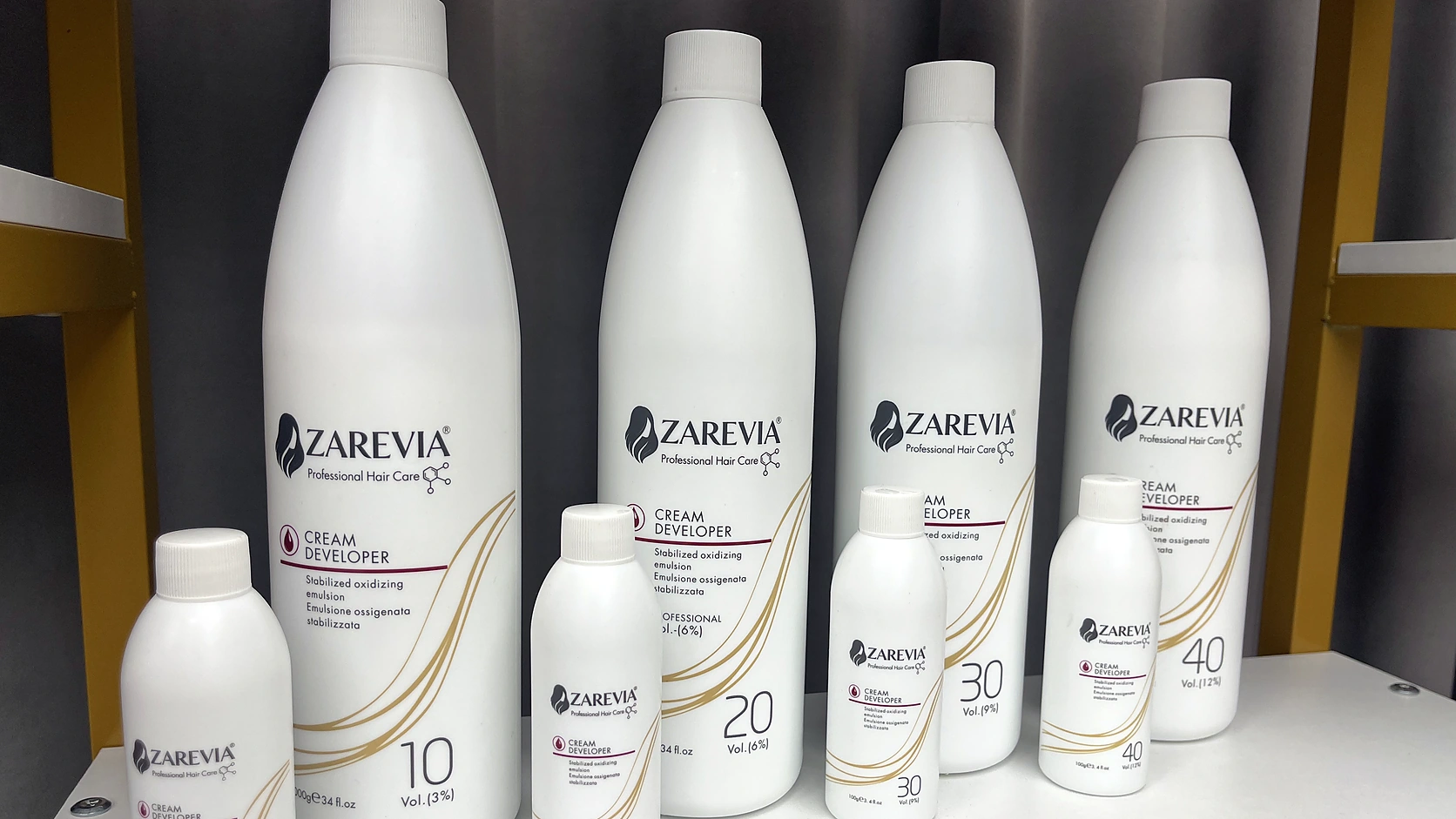
Developer labels indicate peroxide strength—commonly 10 volume at 3%, 20 at 6%, 30 at 9%, and 40 at 12%, as shown in the Matrix Fundamentals of Haircolor. Compatibility and permission come from the specific product system.
This distinction matters. Developer is a finished formula, not peroxide and water in a generic bottle. A professional cream developer is built around stability, buffering, viscosity, and its intended color or lightening system. In product matching, we treat the developer as part of that system rather than a stand-alone peroxide number.
What Volume Do You Get When You Mix Developers?
With equal amounts of two developers, the theoretical result is their average.
| Developer A | Developer B | Equal-parts theoretical result |
|---|---|---|
| 10 volume | 20 volume | 15 volume |
| 10 volume | 30 volume | 20 volume |
| 10 volume | 40 volume | 25 volume |
| 20 volume | 30 volume | 25 volume |
| 20 volume | 40 volume | 30 volume |
| 30 volume | 40 volume | 35 volume |
The table covers the common combinations. Equal parts of 20 and 40 make a theoretical 30 volume; 30 and 10 make 20; 10 and 20 make 15.
The qualifier theoretical matters. A measured 25-volume blend is neither a factory-made product nor, by calculation alone, an approved 25-volume service.
For unequal quantities, use a weighted average:
Target volume =
(Volume A × Amount A + Volume B × Amount B) ÷ Total amount
For example:
1 part 10 volume + 2 parts 40 volume
= (10 × 1 + 40 × 2) ÷ 3
= theoretical 30 volume
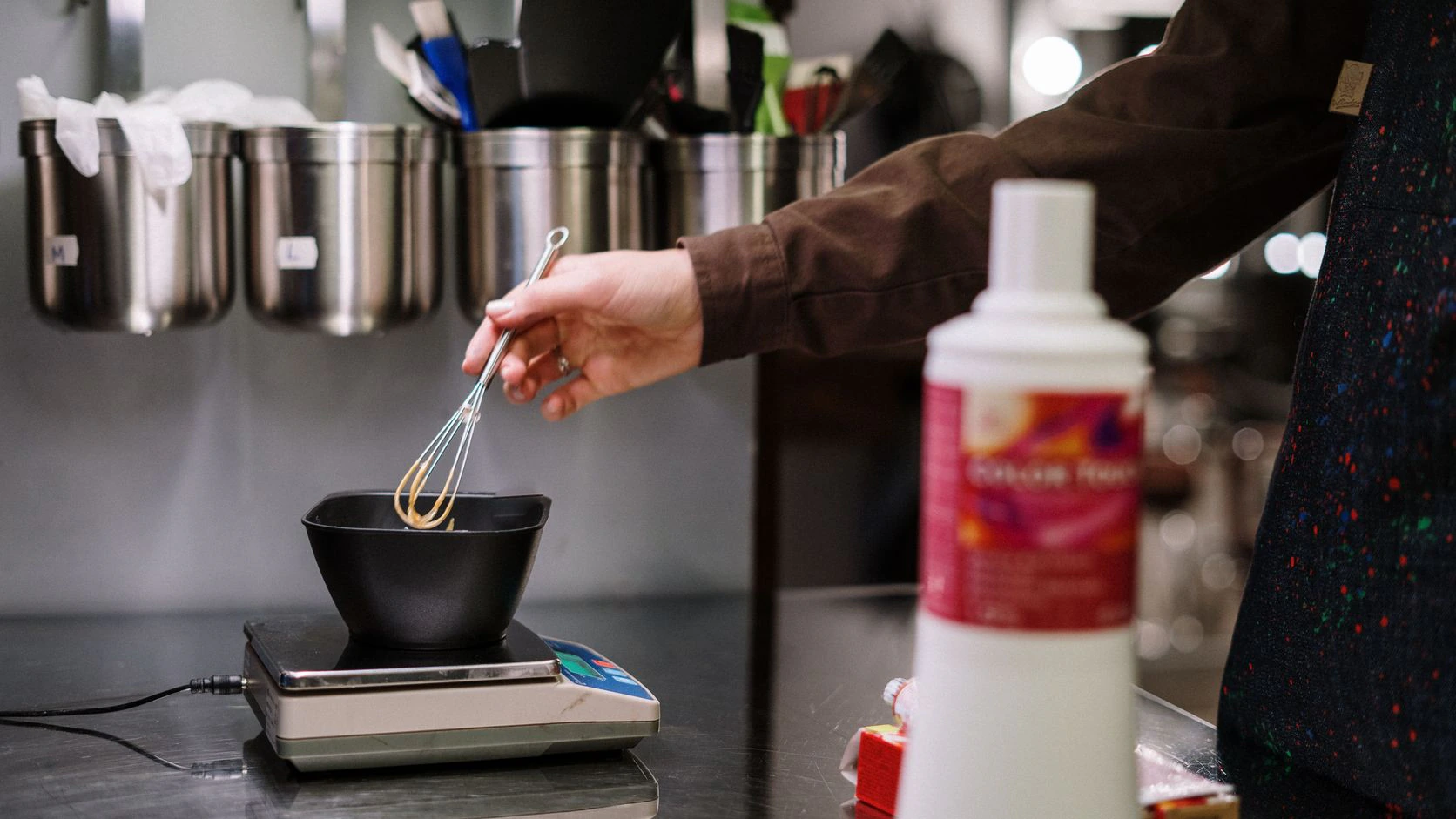
Keep the measurement basis consistent and measure the actual amounts; the product left in each bottle is not a workable estimate. Redken’s guidance also calls for precise measurement when strengths are combined. That permission applies within its defined product context.
Use the correct factory developer when it is available. The formula verifies the strength of an approved blend; it does not replace product permission when inventory runs short.
Do Not Mix Developers Just Because the Numbers Match
“They are both 20 volume” establishes nominal peroxide strength, not compatibility. The label does not show whether the carrier, emulsion, buffer system, stabilizers, surfactants, or viscosity match.
“They are the same brand” is not enough either. A single brand may place permanent-color developer, demi activator, toner emulsion, and lightener-specific developer under the same logo.
Check the evidence in this order:
- Directions for the exact color, toner, or lightener.
- The same approved developer line.
- The same developer type and consistency.
- A volume listed for the final product system.
- Accurate measurement and an unchanged product ratio.
| Weak reason to mix | Evidence that matters |
|---|---|
| Both bottles say 20 volume | Both belong to the approved developer line |
| They share a brand name | The exact color or lightener directions list them |
| The ingredient lists look similar | Type, volume, ratio, and application are specified |
| A strand looked acceptable | Product permission plus service-level verification |
Cross-brand mixing should not be the default. Without manufacturer approval, use the specified developer. A strand test checks the outcome on one sample; formula stability and product permission still come from the product documentation.
The Product System Decides Whether the Blend Belongs in the Bowl
A calculated volume has different implications across permanent color, toner, and bleach.
| Product system | Decision | What to verify |
|---|---|---|
| Permanent oxidative color | Use only a developer and volume listed for the line | Developer family, volume, ratio, and application |
| Demi-permanent color or toner | Do not substitute a permanent developer by matching the number | Dedicated activator or emulsion |
| Bleach or lightener | Follow the lightener-specific system | Approved developer, maximum strength, ratio, and scalp limit |
| Kit or pre-measured system | Do not alter the developer or proportions | Use the supplied components as directed |
Permanent color: Some lines permit several volumes. That approval does not make every developer carrying the same number interchangeable. Matrix Cream Developer, for example, is a stabilized and buffered product for its professional portfolio.
Demi color and toner: L’Oréal Professionnel Dia Color specifies DIActivateur in 6-, 9-, and 15-volume options. A blend of permanent cream developers that reaches the same number is not DIActivateur.
Bleach and lightener: Lighteners may define the developer family, ratio, and maximum on-scalp strength. The Wella Blondor professional guide documents such product-specific limits. A calculated 30 volume remains subject to them.
Kits and dedicated systems: Treat a pre-measured kit as a closed system. Keep its developer, strength, and proportions intact; do not stretch it with more developer, water, or a half bottle from another service.
Three Shortcuts That Are Not Developer Mixing
Searches for “mixing” often describe operations that change different variables:
| Shortcut | Why it is a different decision |
|---|---|
| Adding water or conditioner | This changes a finished developer; it is not a blend of two formulated developers |
| Changing the color-to-developer or lightener-to-developer ratio | This changes the whole bowl ratio, not the developer volume |
| Pouring opened leftovers into one bottle | Immediate service mixing does not establish long-term storage stability |
Water or conditioner is not a universal route from 20 volume to a proper 10-volume developer. Make an adjustment only when the exact product directions provide one. Strength, ratio, and time remain separate variables.
When the back, front, roots, or lengths require different processing, prepare separately planned batches instead of blending every developer into one bowl.
Custom blends do not have a general storage life, and opened bottles should not be consolidated without explicit directions. Keep them separate.
Use This Decision Order Before You Mix
- Identify the exact color, toner, or lightener system.
- Confirm its approved developer line and permitted volumes.
- Check whether the manufacturer expressly allows blending developer strengths.
- Calculate the theoretical result using comparable, accurate measurements.
- Keep the specified product ratio, application method, and scalp limits unchanged.
- Record the formula. Use a strand test to verify a service result—not to prove formulation compatibility.
- If any of the first three checks fail, use the specified factory developer.
If the target strength has not been established, first choose the correct developer volume. Combining two unsuitable choices will not produce the right product decision.
For a salon or private-label color line, match the developer during product selection and testing—not later, based on the number printed on a bottle. This stage confirms viscosity, application control, ratio, packaging, and performance as one working system.
Frequently Asked Questions
Can you mix developers from different brands?
Cross-brand mixing is not the default route. Matching volume and similar ingredient lists do not establish compatibility. Use the developer line approved for the exact color or lightener unless the manufacturers provide clear directions for the proposed combination.
Can you mix developers for bleach or toner?
Mix them when the exact product system permits the combination. Toners and demi colors may require dedicated low-volume activators; lighteners may specify a developer family, maximum volume, ratio, and on-scalp limit. A correct average remains subject to those instructions.
Can you dilute developer with water or conditioner?
There is no universal dilution formula. Water or conditioner changes the finished formula and its consistency; this is different from blending two developer strengths. Make an adjustment only when the exact product directions provide it.
Can you combine leftover developers in one bottle?
The same volume number does not make opened developers suitable for consolidated storage. A blend measured for immediate use and a mixture stored across services are different decisions. Keep opened products in their original containers unless the manufacturer explicitly directs otherwise.
Calculate First—Then Let the Product System Decide
The math is straightforward. The professional question is not “Can these two numbers make 25 or 30 volume?” but “Does this measured blend belong to the exact color, toner, or lightener system?” When product permission is absent, use the specified factory developer.
For a new salon, distributor, or private-label color project, send the target product, market, formula or benchmark, required developer volumes, packaging, and planned quantity through BODA’s OEM, ODM, and private-label project route. Developer matching belongs in the product brief and validation plan—not as an afterthought at the color bowl.